SentencePair
When to use
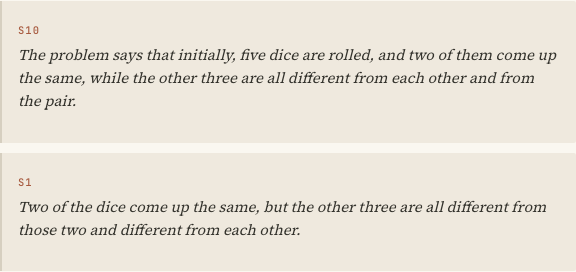
To show two (or more) short text variants side by side, each tagged with a short identifier (A, B, C1, …). Typical use: minimal-pair stimuli, prompt rewrites, or contrastive examples where the reader scans the variants together.
Example
import SentencePair from '../../components/widgets/SentencePair.astro';

<SentencePair blocks={[
  { id: "A", text: "The lawyer who hired the assistant called the client." },
  { id: "B", text: "The lawyer who the assistant hired called the client." },
]} />
Props
| Prop | Type | Required | Notes |
|---|---|---|---|
blocks | Block[] | yes | Array of { id, text } blocks; rendered in order. |
Block shape:
| Field | Type | Required | Notes |
|---|---|---|---|
id | string | yes | Short tag rendered as a leading badge (A, B, etc.). |
text | string | yes | The sentence body. Plain string only — no markdown. |
When not to use
- For more than ~4 variants. Use a table.
- For multi-paragraph passages. Use a 2-column layout.
- For aligned tokens / interlinear annotation. Use a custom component.
- For prose with embedded markup. Inline the prose directly.